
Rename Old Delhi Railway Station to Guru Tegh Bahadur Railway Station, Delhi Junction

A Nation’s Tribute to the Saint Who Gave His Life for Faith, Freedom, and Humanity

A Landmark Rooted in Sacrifice

Few places in India hold the kind of historical and spiritual significance that Old Delhi does.
Amidst the bustling streets of Chandni Chowk and the towering Red Fort lies a sacred chapter of our nation’s history —
the site where Guru Tegh Bahadur Ji, the Ninth Sikh Guru, made the supreme sacrifice to uphold the right to faith and freedom.
It was here, in 1675, that Guru Ji was martyred, refusing to renounce his principles or his stand for justice.
He gave his life not for his own people alone, but for the rights of others — for humanity at large.
Today, the Old Delhi Railway Station, located close to this historic site, witnesses millions of travelers every year.
Yet, many pass through it unaware of the extraordinary courage and compassion that once sanctified this land.
Renaming it to Guru Tegh Bahadur Railway Station would be a powerful act of remembrance —
an acknowledgment that India’s strength lies in its moral spine, its unity in diversity, and its eternal fight for freedom of belief.

Guru Tegh Bahadur Ji

The Shield Of India

Born in 1621 in Amritsar, Guru Tegh Bahadur Ji was a philosopher, poet, and warrior saint.
He taught that true spirituality lies in fearlessness, compassion, and standing up for the truth — even in the face of death.
When the Mughal emperor Aurangzeb began forcing religious conversions, a delegation of Hindu scholars and Kashmiri Pandits sought Guru Ji’s protection.
Guru Tegh Bahadur Ji took an unparalleled stand — defending the right of every person to follow their faith freely, even if it was not his own.
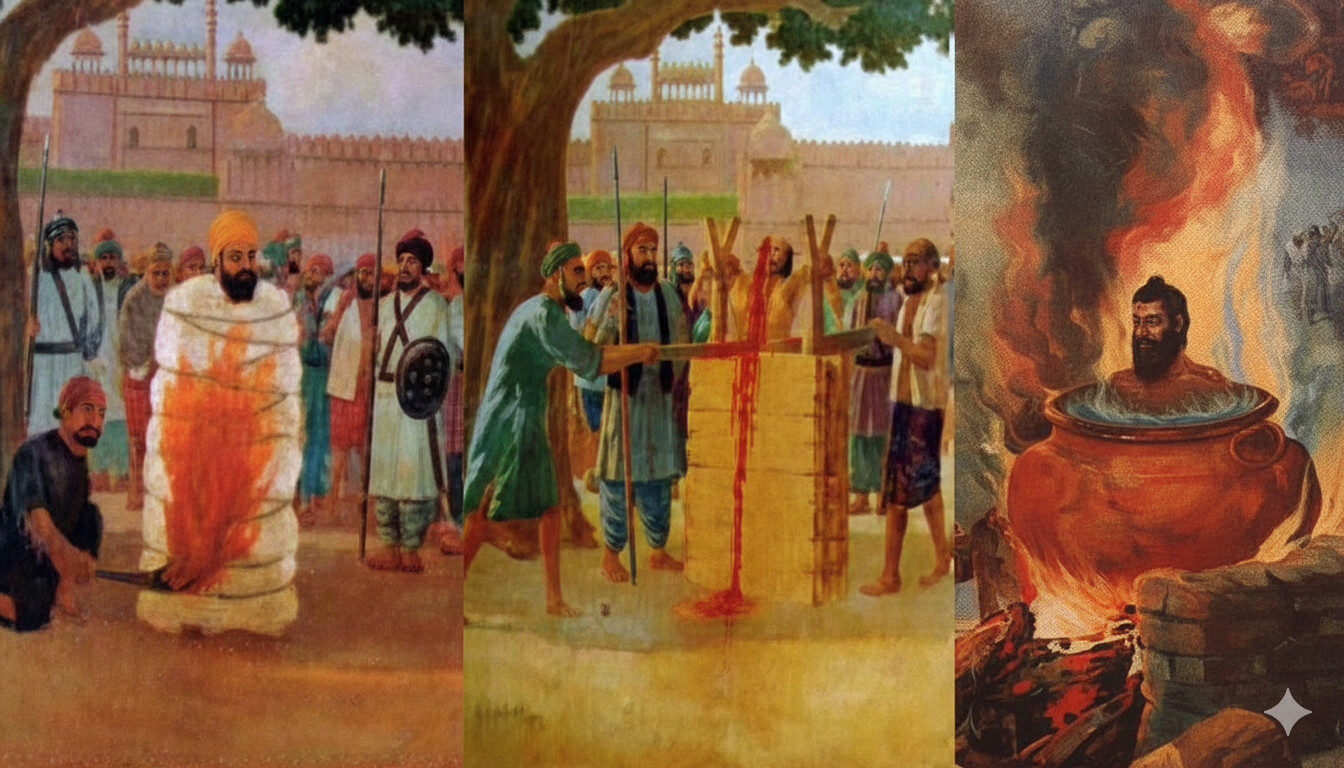
Arrested, tortured, and executed publicly in Delhi, Guru Ji refused to compromise his principles.
His final words and his ultimate sacrifice earned him the title:
“Hind Di Chadar” — The Shield of India.
His martyrdom became a turning point in India’s history — igniting courage, conviction, and resistance against tyranny.

The Day Delhi Witnessed Immortality

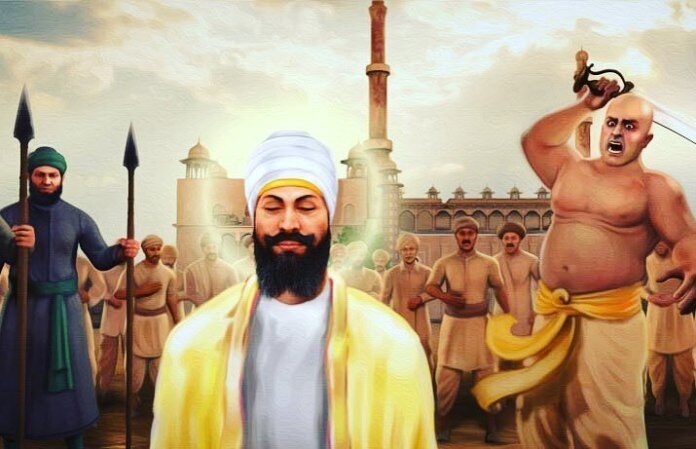
The Martyrdom of Guru Tegh Bahadur Ji

The year was 1675. Delhi stood at the heart of an empire, powerful but fearful — ruled by a king who sought to make faith bow before force.
From Kashmir to the plains of Punjab, the air was heavy with fear.
Families hid their idols, temples fell silent, and thousands prayed for deliverance.
When no one dared to speak, one man did — Guru Tegh Bahadur Ji, the ninth Guru of the Sikhs.
He rose not for his own faith, but for the right of every soul to live in truth.
Summoned to Delhi, Guru Ji faced imprisonment, threats, and unimaginable pressure to abandon his stand.
But no power could shake his calm. His silence was stronger than swords; his courage, greater than empires.
As his closest companions faced death for their faith beside him, Guru Ji’s spirit remained unbroken.
In the crowded square of Chandni Chowk, under the open sky, he bowed his head only to God — and gave his life for the freedom of all.
The earth wept, but history stood still.
That day, Delhi did not witness a death — it witnessed the birth of eternal courage.
Where his blood touched the soil, Gurdwara Sis Ganj Sahib stands today, and the streets that once echoed with fear now echo with faith.
Centuries later, the story of Guru Tegh Bahadur Ji still calls to us —
to speak when silence is easy,
to stand when others bow,
and to live with the same fearless devotion that made him the Shield of India.

Why the Renaming Matters

Renaming Old Delhi Railway Station to Guru Tegh Bahadur Railway Station (Delhi Junction) is more than symbolic —
it is a step toward historical acknowledgment, moral gratitude, and national unity.

Guru Ji’s sacrifice represents the essence of India — a land where every individual has the right to worship freely and live with dignity.
Naming a central landmark after him is a reminder of that eternal truth.

Each day, thousands travel through this railway station — students, workers, families, tourists.
By carrying Guru Tegh Bahadur Ji’s name, the station would become a living classroom of Indian history and values, inspiring millions to learn about his teachings of tolerance and courage.

Delhi was the city that witnessed his martyrdom.
The Sis Ganj Sahib Gurudwara stands nearby as a testimony to his bravery and faith.
Renaming the railway station close to this site is not just apt — it is deeply meaningful.

Guru Ji stood for every community, not just his own.
He taught that spirituality transcends religion, and justice belongs to all.
Honouring him reinforces India’s timeless message: we are strongest when we protect each other’s freedom.

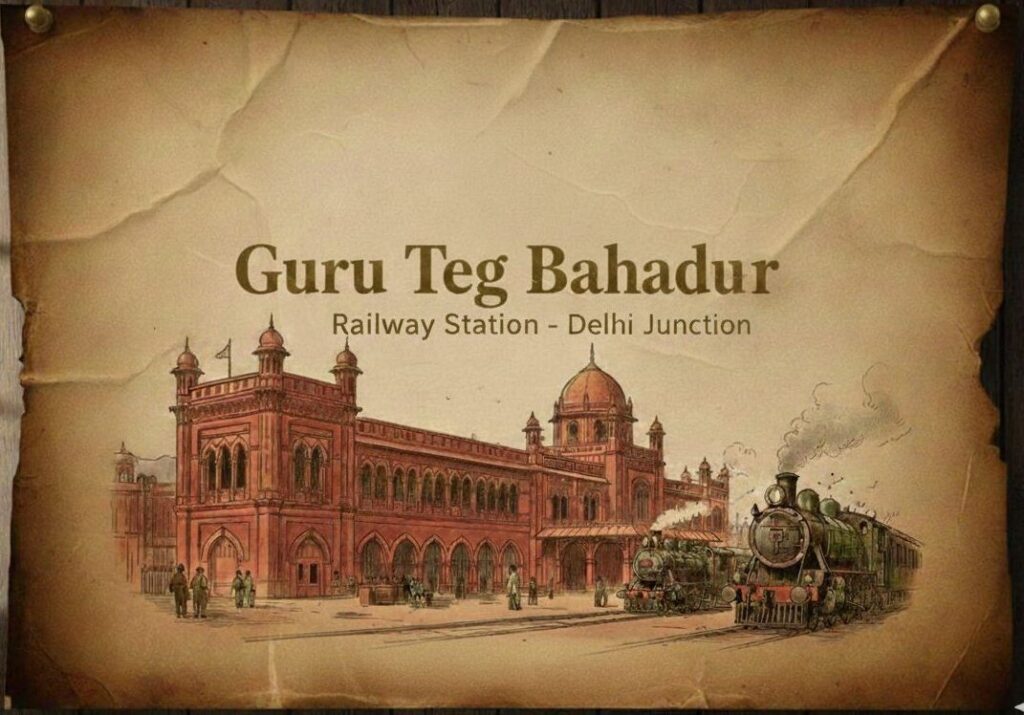
Railway Station Design Fabrication by The Urban Heaven
A Call to the Government of India

We, the citizens of India — across faiths, languages, and generations — humbly appeal to the Government of India to rename Old Delhi Railway Station as “Guru Tegh Bahadur Railway Station (Delhi Junction).”

This is not just a change of name.
It is the restoration of honour to a saint who gave his life so that others could live freely.

Guru Tegh Bahadur Ji’s supreme sacrifice was not for one community, but for the soul of India itself.
At a time when tyranny demanded conversion, he stood tall for the right of every person to practice their faith without fear.
His martyrdom in 1675 laid the foundation of freedom of conscience — centuries before the world even spoke of human rights.

Delhi, the city that witnessed his courage, should carry his name with pride.
The Old Delhi Railway Station — one of the oldest and most recognized gateways of the capital — must become a beacon of remembrance and respect.

We believe this renaming will:

1. Honour the martyr who protected India’s spiritual diversity.

2. Educate millions who pass through the station daily.

3. Strengthen our nation’s moral and cultural heritage.

By renaming this station, India will send a timeless message:

We remember. We honour. We stand united.

Let Delhi Remember Its Shield

Guru Tegh Bahadur Ji’s sacrifice is not just history — it is India’s heartbeat.
Every traveler who passes through Delhi walks upon the soil that witnessed his courage and compassion.

Now, it’s our turn to honour him.
Let us unite as citizens — Sikhs, Hindus, Muslims, Christians, and all — to give Delhi a name that reflects its conscience.

Renaming Old Delhi Railway Station to Guru Tegh Bahadur Railway Station (Delhi Junction) is not merely a symbolic act —
it is a national statement that India remembers those who stood for truth, tolerance, and freedom.

✨ How You Can Be Part of History:

Together, let’s ensure that generations to come never forget the saint who gave his life so others could live in freedom.
Let Delhi’s oldest station carry a name worthy of its spirit —

Guru Tegh Bahadur Railway Station — The Shield of India

One Vote can change Everything

Petitioners

Shri Guru Teg Bahadur Sahib Group

Sardar Rajender Singh Chhabra

Rashtriya Sanyojak, Shri Guru Teg Bahadur Sahib Group

Sardarni Gurmeet Kaur

Mohalla Kot, Amroha, UP

Rajat Auluck

Founder, The Urban Heaven, Delhi

Preety Auluck

Website Developer & Founder, BeNext, Delhi

Karan Gurdittaa

Website Developer & Founder, Zolo Innovations

Sardarni Inderjeet Kaur Kathuriya

Pune

Sardar Charanjit Singh Titu Bhai

Aligarh

Sardar Rajender Singh Raju Bhai

Rudrapur

Sub Major(R) Sardar Joginder Singh Bankura

Samana urf Ramraj, Jansath, Muzaffarnager

Sardar Baljeet Singh

Haldwani

Sardar Balbir Singh Hora

Sec 67, Gurugram

Sardar Bhupender Singh Pappi

Pradhan Khariar Road, Orissa

Sardar Bhupender Singh Raju Bhai

Ludhiana

Sardar Jaspal Singh Gandhi Bhola

Orissa

Sardar Manprit Singh Walia

Surat, Gujarat

Sardar Amarjeet Singh Gurdatta

Mahasamund, Chhattisgarh

Sardar Jagjit Singh Chhabra

Amroha, UP